When a new wind farm moves in next door: why default wake parameters break down onshore
Most wind analysts know the standard routine for yield assessments. We open our software, pick a wake model, choose a wake recovery rate we think is appropriate, and run it. For a long time, the industry standard was the Jensen top-hat model with fixed wake decay constants—typically 0.075 onshore and 0.04 offshore or other more specific values depending on the terrain. Even as we’ve moved to other approaches with Gaussian and deep-array models, the habit remains: pick a model, use the textbook parameter, and trust the output.
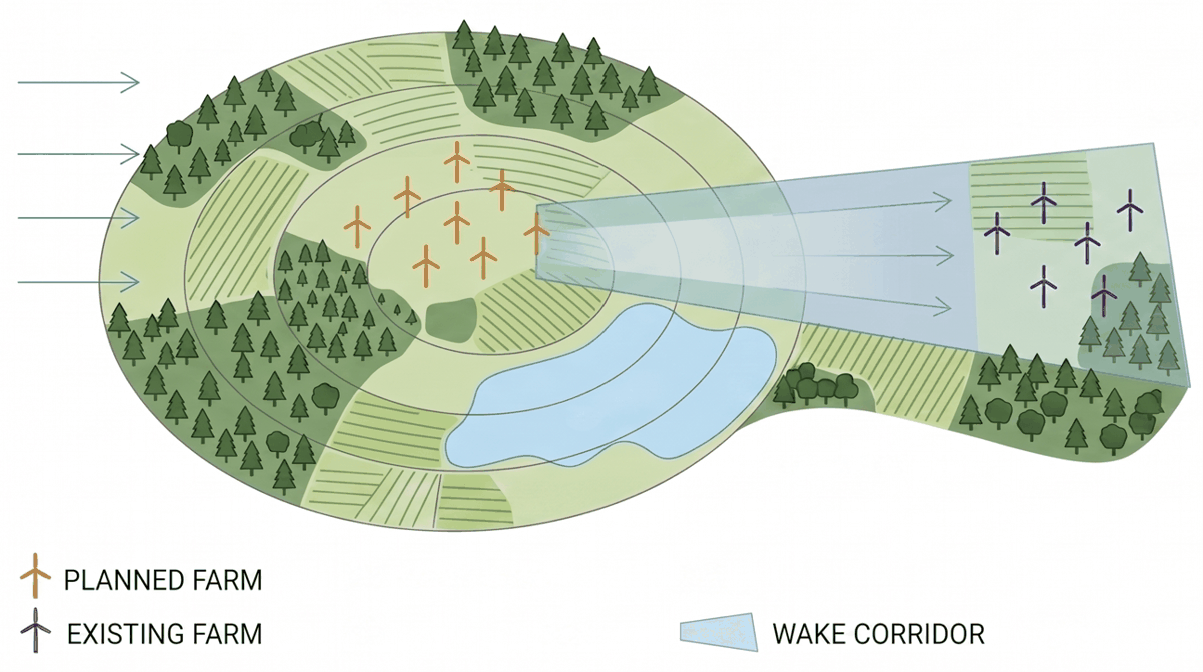
This, however, can be very problematic. We recently worked on a case just like this: a new wind farm was planned upwind of an operational onshore farm in complex terrain, directly in the prevailing wind direction. Both the existing owner and the new developer had done their modelling. The existing owner’s report showed the new farm would cause major production losses. The developer’s report concluded the impact would be minimal. Same turbines, same layouts, same wind data, but completely different conclusions.
When we looked at both analyses, the reason was fairly obvious. Both teams used similar wake models and set them up rather well. The only real difference was one input: the wake recovery rate. The existing owner used a value typical of open, low-roughness farmland (where wakes persist longer and losses are higher). The developer used a value typical of rougher, forested terrain (where wakes break down faster and losses are lower). Unsurprisingly, each choice also happened to favour the party using it!
The real question, which neither report answered, was what the actual recovery rate should be for this specific site, which was a mix of farmland, forestry, open moorland, and a reservoir. It wasn’t cleanly “open” or “forested.” That single parameter choice drove the entire result, highlighting how often the industry relies on default parameters for these important decisions.
The recovery rate isn’t a constant; it’s a summary of everything we didn’t model
The wake recovery rate (like the k constant in Gaussian-type models or the A parameter in TurbOPark) dictates how fast a wake mixes with the surrounding air. It’s an empirical parameter doing a lot of heavy lifting. It essentially encapsulates lots of information related to atmospheric stability, ambient turbulence, surface roughness, and terrain features. Things the engineering model doesn’t explicitly resolve.
Onshore, this is especially critical. Moving from patchy forestry to open moorland changes the ambient turbulence significantly. A wake that dissipates quickly over rough terrain can persist much further over smooth ground. Depending on the recovery rate used, the estimated wake losses from a neighbouring farm can swing enough to alter a compensation claim or an investment decision. Relying on a conventional default rather than site-specific evidence introduces a lot of hidden uncertainty.
Calibrating to your own wind farm doesn’t mean the parameters apply next door
Here is a more subtle issue. Suppose we have a few years of SCADA data from the existing wind farm. We calculate the ideal energy (accounting for curtailment, density correction, etc), apply long-term corrections, and tune our wake model until it matches the actual production. In our case, two wake engineering models were tested/calibrated to within 3% of the SCADA-based yield. At that point, it’s tempting to say the model is validated and use it directly for the new neighbouring farm. But we need to think about what was actually validated: the wakes inside the existing wind farm, over that specific patch of ground. The new farm presents a different scenario. The wakes from the planned turbines will travel over a stretch of terrain that the existing farm’s internal wakes never see. If the roughness, slope, or flow characteristics in that corridor are different, the recovery rate you tuned using SCADA data might not apply to the wakes coming from the new neighbour.
Before reusing the calibrated parameters, we compared the two areas: we looked at elevation, slope, and roughness averaged over the internal cluster, and compared it to the corridor between the new farm and the existing one. The roughness was very similar. The slope was slightly higher in the corridor, which normally implies slightly faster wake recovery due to increased terrain-induced turbulence.
The often-ignored parameter: pressure gradient effects
Then there are aerodynamic effects that rarely make it into standard energy assessments. In this project, the near-wakes of the critical upwind turbines formed mainly on the lee side of hills, where the flow decelerates as it moves downstream. This creates an adverse pressure gradient. We know from many experimental and numerical research studies that wake recovery slows down noticeably under these conditions because the mixing process is suppressed. Addressing this delayed wake recovery is the focus of our ongoing research.
So, we had two competing effects. The slope suggested slightly faster recovery, while the adverse pressure gradient suggested slower recovery. Neither of these effects is captured by a standard engineering model using a textbook decay constant. Finding the exact balance would require terrain-resolving CFD with wakes; a great research topic, but outside the scope and budget of a standard non-bankable energy assessment. However, acknowledging these physics, checking if they apply to your site, and honestly assessing whether your parameters still make sense is within budget. In our study, after comparing these factors, we concluded the parameters were still reasonable to use. But we had to justify that conclusion, not just assume it.
Reflections on a more robust onshore wake assessment approach
A few insights we learned and can share from this and similar jobs:
- Anchor to operational data: If the affected farm is running, a SCADA-based post-construction assessment should be the foundation. Our models need to reproduce historical data before we use them for predictions.
- Treat parameters as site evidence, not default settings: If we calibrate a recovery rate in one area, we need to justify using it in another. We need to carefully compare the roughness, slope, and flow among other relevant parameters along the actual wake path.
- Acknowledge unmodelled physics: We need to think critically about pressure gradients, stability, and lee-slope effects. Even if we can’t model them explicitly, we can estimate their directional impact and perhaps account for them in our uncertainty analysis.
Engineering wake models are very valuable. They are fast and useful approximations. But their accuracy depends entirely on their parameters. For onshore sites in complex terrain with a new neighbour moving in, a default value is the last thing we should rely on.
Anemona provides yield assessment and LCOE optimisation for wind projects. If you are dealing with a farm wake dispute, on either side of the fence, feel free to reach out.